Placemats

Posted by ginger On Friday, June 27, 2008

For a while, I've had the idea of laminating paper menus from some of our favorite restaurants so that our children can have something different at each meal to use as a placemat. Av got them laminated for us, and they turned out great!


(above:) We've got placemats now from Bright Star, Lusco's, Attman's, Cotton Patch, Walnut Hills, Primo's, McGuire's, Stamps Superburger...

(below:)Niki's West, Mary Mac's, Wintzell's, Schwartz's in Montreal, Faidley's in Baltimore, the old Sal and Sam's, even a peach pie wrapper from The Varsity that I guess can be a drink coaster...

On Tuesday of this week, Av came home for a couple of hours in the middle of the day so Leslie and I could have girl-time (I think this is the first time in weeks - since I went to knit-night last - that I have been away from Shug! Oh it was so hard to leave the house without that sweet little boy!!). We went to Chez Fonfon in B'ham and it was soooooo good...another one to laminate!
Hopefully when they get older the boys will have a good time deciding which placemat to use - and it will give them something to practice reading with too.

---
I've also been saving mayonnaise and applesauce jars for catching lightning bugs!

Free Gasoline

Posted by ginger On Thursday, June 26, 2008

There was an article emailed to me from this past weekend's AJC titled "Invasive Kudzu Studied As Source Of Ethanol" (y'all know I love kudzu...). It's about a researcher from Canada and some other people at the USDA looking at kudzu as a possible fuel source.

Here are some excerpts:

The plant is a fast-growing, woody vine that can grow up to 60 feet in one season. Its underground roots, around the diameter of an adult forearm, store plenty of starch essential for ethanol production. Kudzu exists mostly in the southeast but is native to China and Japan, where the starchy roots have long been used for cooking and thickening sauces.

In the U.S., especially in the southeast where it grows rampantly, the plant is considered a nuisance.

"You may have heard of it as 'the plant that ate the South,'" said Sage, who teaches botany and ecology. "It takes over fields, covers trees and houses and causes a lot of economic damage."

---

"The problem with corn is you've got to grow it, you've got to use a lot of fertilizer and pesticides to plant it and harvest it," Sage said. "Corn is not that big of a gain and some people say that without federal subsidies the corn ethanol market would probably fail."

The study found that the amount of energy that can be extracted from kudzu is similar to that of corn. For instance, 900 to 2500 liters of ethanol can be converted per hectare of kudzu, compared to 2000 to 3000 liters per hectare of corn, Sage said.

---

Brazil, the world's biggest exporter of ethanol, depends on sugar cane. Dulce Fernandes, associate director of Network for New Energy Choices, a New York City-based nonprofit environmental organization, said sugar cane grows quickly and is less resource intensive than corn. However, the United States does not have the right climate to grow it at Brazil's rate. In India, researchers are testing a shrub called Jatropha that is native in many parts of the country.

---

Sage said kudzu must undergo further study. It is uncertain whether the plant is economically feasible to harvest. No techniques exist and it remains to be seen whether new farm equipment must be created in order to pull the plant's roots out of the ground. Also, while there is plenty of kudzu in the southeast, an increase in demand could be problematic as current regulations do not allow cultivation of the noxious weed.


Well...I looked into this a little bit, and it sounds like the researchers in the AJC article need to talk to Agro*Gas Industries in Cleveland, Tennessee, because they've had the idea for a while now and are planning to be in production in 2009!

From an article I found about them:

“This is a version of 180-proof ethanol made from the kudzu plant,” explained Doug Mizell, co-founder of Agro*Gas Industries in Cleveland, Tennessee, as he points to a jar filled with clear liquid.

Mizell and company co-founder, Tom Monahan, have dubbed the kudzu-based-ethanol, “Kudzunol.”

Not only do they make it, the two believe the suffocating weed that has become an annoyance might just be a saving grace at the fuel pump.

“Everybody knows that you can make ethanol from corn and soy bean,” said Mizell. “What most people don’t know is that you can make ethanol from anything green.”

So, instead of fuel and feed, Agro*Gas is putting their energy into converting what is readily available and cheap.

---

“There’s 7.2 million acres of kudzu in the south that’s absolutely good to no one,” said Mizell. “It grows a foot a day, 60 feet a season and can be harvested twice a year and not even hurt the stand.”

---

Mizell says the ethanol process is simply “Moonshine 101” and has not changed in 500 years.

Agro*Gas plans to build a cellulosic plant to produce the Kudzonol and bio-diesel, Green D.

The ethanol producing plant would be small, regional, and reliant on local farmers.

“Farmers still can’t believe the fact that we would actually pay them for stuff they now throw away or turn under,” said Monahan. “It’s like, ‘I can’t believe it’s true until I see the money.’”

Agro*Gas plans to break ground on an ethanol producing plant in McMinn County or a surrounding county by end of the year and hopefully begin production in 2009.

The plant will be environmentally friendly and funded by private dollars.

Currently Monahan and Mizell are working with investors across the country as well as local farmers.


Which means...we're all going to be rich! Well, not really. But still. How many Jed Clampetts do you know?

Come and listen to a story about a man named Av

A real city boy, Whole Foods kept his family fed

Then one day his yard was covered as could be

'Cause up through the ground came a mile-long vine of green...

Kudzu that is. Emerald gold. Bama tea.

Okay, okay. That was pretty weak. But I couldn't help myself! Because you know what? This is what our backyard looks like. Well, the area behind the backyard - our lot includes up to the top of the mountain, so this is the area that's not cleared. And this tree is covered in ivy and honeysuckle and wisteria and kudzu. Mostly kudzu:


Av chopped off a few yards of kudzu to see if it would fill the Volvo up:
He's ahead of his time.

Jim Bird's Hay Critters, Farm Art, Messages, and Butter Sculpting

Posted by ginger On Wednesday, June 25, 2008


The July/August issue of AAA magazine - Alabama Journey - has a feature on Jim Bird's "hay critters" (that's what he calls them). They're on his farm along US 43 in Forkland, Alabama, between Demopolis and Eutaw and really something to see.

He says his next creation may be a flower in a pot - he made one years ago with a florist and her husband who were on their way to the beach and stopped for a visit...they wound up staying for hours.

Our visit to Mr. Bird's farm is at this post.

---
Other people's hay sculptures:

Tractor
Makin' Hay, a three-piece sculpture by artist Tom Otterness in Stanford, California (although it's a traveling exhibit so it may be somewhere else right now)
Buffalo
An ice cream manufacturer in England has a hay satellite dish as their 'dish of the day'
Stonehenge made of hay in Australia

---
Corn...

Corn sculptures
in Thailand
Corn dragon in China
...this is not made of actual corn, but there's a field of concrete corn in Dublin, Ohio
...and there's flying corn at the airport in Atlanta

---
Two years ago I took these pics of messages on cotton modules:


---
...and at the Iowa State Fair, since the early 1900s, they've had a butter cow sculpted. And not only that, but they've done butter sculptures of Tiger Woods, Harry Potter, John Wayne, and Superman. Oh, and Iowa isn't the only state fair that does this. Texas, Ohio, and New York do it too. Our troops at Camp Anaconda in Iraq made this Thanksgiving sculpture out of margarine because they didn't have butter (can we not get these people butter for goodness sakes!!??) - pretty great!

Shelbyville, Tennessee

Posted by ginger On Tuesday, June 24, 2008

On our way home from Bell Buckle, we went through Shelbyville, Tennessee. Shelbyville is the 'Walking Horse Capital of the World' and...I didn't know this until I went to the Shelbyville visitor website, but they're the home of Sharpies! Oh, I do love Sharpies.

Anyway. Shelbyville is huge when it comes to horses. That's where the Tennessee Walking Horse National Celebration is held every year and over 250,000 attend. So I guess it's natural that they have motel signs like this:


And this doesn't have anything to do with horses, but in Shelbyville, you can get a free Bible at the used car lot:

On the way out of town, we saw a *huge* cemetery. This is Amie Boyd Marks' stone, and when her time comes she will be (see the line at the bottom) "gone to the big horse show in the sky"! You know she would have to be just about the most fun, with the best personality, to have this monument!!

In town there is this old Coca-Cola mural:

...and this one for Chero-Cola, which was made by the RC people ages ago:
On Flickr, there's a group called Ghost Signs, where over 700 people have put old commercial murals up.

Emmys

Posted by ginger On Tuesday, June 24, 2008


Av got an email from his high school classmate, Celia Carey, this morning saying that the Mr. Dial Has Something To Say documentary that she directed/produced won four Emmys this past weekend: outstanding editing, documentary, photography, and director of post production!

RC and Moon Pie Festival, Bell Buckle Tennessee

Posted by ginger On Monday, June 23, 2008

This weekend, we drove up to Bell Buckle, Tennessee for the RC and Moon Pie Festival. We got to see some of the contests - this is the RC dash, where contestants walk with cans of RC on their head:

...and after this was the watermelon seed-spitting contest. All day, there were different activities: a race, people clogging, a RC-Moon Pie recipe contest, a wading pool play called "A Midsummer's Nightmare" where GooGoo Cluster tries to steal RC Cola from Moon Pie (there's a pic of it here), and towards the end of the day, the largest Moon Pie is cut into and served.

There were some special painted pieces for sale too - this table ($1800):

Stool ($950/pr):

Chair ($1400):
Gosh you know I *loved* those and they've inspired me to take out my paints and do my own thing. It's great that a lucky someone is getting to take these home!


Daddy of course snacked on a RC and a Moon Pie. Shug is *waaay* too little to enjoy them, but daddy put them on his stroller tray just for a pic, and look at what Shug went after!

Season's Over

Posted by ginger On Monday, June 23, 2008

The last crawfish boil of the season last week. Mmmm.

The White Lily Answer

Posted by ginger On Sunday, June 22, 2008


Thank you - thank you - thank you to Joanne, who emailed me with the answer to the code for Knoxville-milled White Lily!

Look for the "Best if used by" date stamp, like on my sack of flour above. Underneath the "best if" line is a series of numbers.

  • The first number indicates year. So this flour was milled in "8" = 2008.
  • The next three numbers indicate the day of the year. The 108th day of this year was April 17th.
  • The next three numbers indicate the plant code. The Knoxville code is/was 569.

Joanne - really - (and I am sending you an email back too, but...) thank you soooo much!!

White Lily Update

Posted by ginger On Friday, June 20, 2008


(original post)

I was so tickled to get all those emails about those of you also being interested in buying Knoxville-milled White Lily at the store before it's all gone!

I didn't get a response to the email I sent White Lily on Wednesday. This was the message I had sent them:

Hi - I understand that the White Lily mill in Knoxville is closing, and I want to stock up on it so that I can avoid the new flour being milled up north. I plan to purchase several, several, several bags this weekend. Can you please tell me how I can differentiate on the bag between the flour made in Knoxville and that made elsewhere?
So...I decided to call them. I talked to Lori Ann, and asked her to please tell me the code on the bags of White Lily for the Knoxville mill. She wouldn't tell me the code (and, really, you *know* they have a code on those bags because of all the food recalls that go on, so the FDA and whoever else can trace tainted ingredients back to their source. We aren't talking produce w/out barcodes.) but she *did* say that everything that is on store shelves right now was milled in Knoxville.

I told her it was my understanding that the mills up north were already making White Lily. Does that mean that those mills haven't started shipping the flour yet? She didn't answer that but again said that everything that is on the store shelves right now is from Knoxville.

Really, I would be happy with that explanation but I don't understand why I couldn't just get the code so I would know that the 'x' number of bags I buy this weekend really are from Knoxville. You know?

She added that there was no way I would be able to tell the difference between Knoxville White Lily and the newly made flour anyway.

Well, I couldn't help myself, so I very nicely asked her if she read the article in the NY Times which says that two other sources could tell the difference. She said that it was a (okay, yes! I did take notes!! you know me!!) "flawed test" and that one of the testers was a "former employee" so there you go.

I told her that the other tester, though, was not employed by the company and she gave me the pause. You know, .......the pause........ After a few seconds, she said that they had a "lady in their kitchen that worked there over 14 years that could not tell the difference" and that the color change between Knoxville and the other mill was due to the fact that "flour changes color in age" meaning I guess that the other mill's flour may have been older than the comparison from Knoxville. So how long then has the other mill been making White Lily without shipping it since everything on store shelves right now is from Knoxville? I'm not sure how much sense that makes.

Lori Ann was really nice and I thanked her for helping me. I do wish that she would have just told me that code, though! Maybe they aren't supposed to because then they would have so many people wanting to stock up and freeze Knoxville flour. Of course, they are still making money on any sales no matter where the flour originated, so...not sure that makes any difference either...

It sounds like their office has had a *lot* of calls about this. If anyone else has any questions - or wants to try to get the code(!!) - their # is 800.595.1380. You have to promise me you'll email me if you get it! hahaha!!

---
Updated: got the code!

Fried Pickles

Posted by ginger On Friday, June 20, 2008

Last night for supper, I made up some fish, and to go along with it, fried pickles.

Av loves fried pickles...

His favorites are from Ezell's Fish Camp in Lavaca, Alabama:
Fried Pickles at Ezell's Fish Camp, Lavaca AL

These are from somewhere else...not quite as good because they're so thin and there's so much extra crust:
Fried Pickles

These were a mostly cornmeal crust:
Fried Pickles

These came from a barbecue place in Fultondale, Alabama where they fry the whole spear:
Fried Pickles, Porky's Pride BBQ, Fultondale AL

The secret to really good fried pickles is that the pickles are cut thick enough to stay "pickley" and of course that they not at all be greasy. These turn out great...

  • In a skillet, put oil on to 350*.
  • Prepare a plate with paper toweling so the finished pickles can drain well, and set the oven to 200* so that if you're doing several batches, or if they will be done a little earlier than other things, they can stay nice and warm.
  • For every two people, you need one whole pickle (if you're serving this as a side dish). For this recipe, I really suggest Claussen because they really do stay crisp. Cut into nice-size pieces:

  • The egg wash ratio is: one egg to one cup of milk. This egg wash is enough for at least six or seven pickles (12-14 servings):

  • In a Ziploc bag, put enough flour (or cornmeal, or a ratio of cornmeal to flour that you like) to coat the number of pickles you're cooking plus seasoning - the amount of seasoning is going to be different for every family according to taste...but we like things pretty spiced-up, so I put several great-big dashes of Tony Chachere's in the bag. If I weren't using Tony Chachere's, it would be something like cayenne pepper plus garlic salt and pepper. None of this is exact - it's just whatever looks and sounds good:

  • Put the pickle pieces in the egg wash:

  • Remove them with a slotted spoon so the extra egg wash can drip off, then place the pickles in the ziploc bag and shake to coat. Shake, shake, shake.
  • Make sure the oil is at 350* (if you put them in at a lower temperature, they will soak up the oil and not be good). Lift each pickle piece out of the bag separately and gently place in the skillet to fry:
I use an electric skillet to fry in. I sooo wish I could say I use a cast iron skillet for frying but the truth is, I have this fear of burning the whole house down if it were left up to me to get the oil temperature steady in anything else.

The pickles only take a few minutes on each side (get one side golden brown, then flip to the other side):

Place the finished pickles on the plate with the paper toweling, and place that in the 200* oven to stay nice and warm while everything else finishes.

Oh these turn out so great! Super-crisp and not at all greasy. Yum!

If these are for an appetizer, they can be served with a nice dip - remoulade or comeback sauce is nice.

Salt and Pepper Shaker Tassel

Posted by ginger On Wednesday, June 18, 2008

Last year, there was an article in Mississippi Magazine about salt and pepper shaker tassels. All you do is just take an old salt or pepper shaker, thread a cord in the top, and put a tassel in the other end.

Supplies:
shaker with a hole in the bottom (so those screw-cap ones obv. won't work)
either skinny gold cord, or embroidery thread & embroidery needle
various ribbons (or you can use yarn, etc)
hot glue

This project is *so* much easier if you use a shaker that is short, because you won't have a hard time getting the cord or thread to go through the top holes and down to where you can reach it on the bottom. If you use really tall shakers like these:

...it's a lot more difficult (these are 4" tall) and rather than tying a knot in the cord, I've had to glue the cord to stay put. It still looks good, but you just have to be careful to do a very neat job hot gluing.

The shakers must have a hole in the bottom so you'll have a place to nest the tassel:

To make the hanger, I took embroidery thread and put it on a long needle to get it to go from the bottom of the shaker, through one of the top holes, and down through the other.

Here I placed little tiny dabs of hot glue at each hole in the top of the shaker to secure the thread. I flattened out the glue while it was still hot so it would look neat and not at all noticeable.

I like brown and turquoise together, so I got five different patterns of brown ribbon:

...and cut them all either 12" or 13" long so there would be some variation. I wanted the ribbons to hang somewhere around 150% the length of the shaker (so since the shaker is 4" long and once the tassel is made the 12" strips will be folded in half to be 6" long, that pretty much works out).

For this tassel, I cut seventeen strips of ribbon. Some ribbon patterns I only cut two of and others (like the skinny one) I cut more.

Here are all the strips laid out:
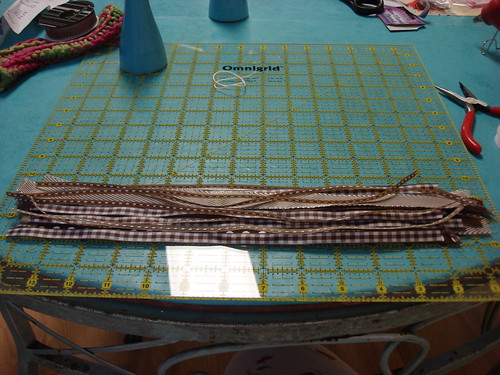
I put a new long skinny ribbon underneath all the others, right in the middle:

...and knotted it:

Then I pulled down both sides and knotted that with a new piece of skinny ribbon to make the tassel shape:

I stuffed the top of the tassel in the shaker bottom (and neatly hot glued around the inside there to make it secure):

Cut fish-tails into the large ribbon ends (I left the small and medium-width ribbons flat since they won't unravel):

Fluffed it all out a bit, and here it is!:

What do you think!?

Oh Nooooo!

Posted by ginger On Wednesday, June 18, 2008

This morning, my friends Alan and Tammy sent me emails with the article from today's NY Times about the White Lily mill in Knoxville closing.

Smucker's has bought White Lily and they are making it up north. As of the end of *this month*, White Lily won't be Southern any more! And not just that, but what makes White Lily what it is - the source of the wheat and the exact way it's milled...well, here is the entire article and here are some excerpts:

FOR generations of Southern bakers, the secret to weightless biscuits has been one simple ingredient passed from grandmother to mother to child: White Lily all-purpose flour.

Biscuit dives and high-end Southern restaurants like Watershed in Atlanta and Blackberry Farm outside Knoxville use it. Blue-ribbon winners at state fair baking contests depend on it. On food lovers’ Web sites, transplanted Southerners share tips on where to find it, and some of them returning from trips back home have been known to attract attention when airport security officers detect a suspicious white dust on their luggage.

White Lily is distinctly Southern: it has been milled here in downtown Knoxville since 1883 and its white bags (extra tall because the flour weighs less per cup than other brands) are distributed almost solely in Southern supermarkets, although specialty stores like Williams-Sonoma and Dean & DeLuca have carried it at premium prices.

But at the end of June, the mill, with its shiny wood floors, turquoise and red grinders and jiggling armoire-size sifters, will shut its doors. The J. M. Smucker Company, which bought the brand a year ago, has already begun producing White Lily at two plants in the Midwest, causing ripples of anxiety that Southern biscuits will never be the same.

Maribeth Badertscher, a spokeswoman for the company, said the new White Lily was the result of thorough product testing and promised that customers “won’t know the difference.” But in a blind test for The New York Times, two bakers could immediately tell the old from the new.

---

The passion for White Lily is more than simple nostalgia.

“All you have to do is take a little bit in your hand and take some all-purpose flour in the other hand and just look at it,” said Shirley O. Corriher, the Atlanta-based author of “CookWise,” about the science of cooking, and a forthcoming companion volume called “BakeWise.” “There’s an incredible difference. It’s much, much finer, much whiter and much silkier. You’re going to get a finer textured cake.”

---

It may also explain why many Northerners’ attempts to replicate Southern delicacies fall flat. Low-protein flour absorbs less liquid, so a recipe designed for White Lily won’t work with other flours. Cake flour or another low-protein flour like Martha White are the closest substitutes.

---

Carolyn Durst, 62, a sweepstakes winner in the pie competition at the Kentucky State Fair, said, “I give pie crust demonstrations to my friends, and I tell them, No. 1, you’ve got to have White Lily flour.”

---

A blind test by two bakers, who were sent bags of the old and new product marked only A and B, underscored Ms. Corriher’s concern.

Zoellyn Smith, who worked in both quality control and research and development at the Knoxville plant, accurately identified the new product before she began to bake. Sample A, the new product, had “a grayish color” and made a “dense and chewy” cake, while Sample B, the old, made for silky, rather than stiff, dough and a “light and airy” cake.

“When I looked at just the flour I thought that Sample B was milled in Knoxville,” she said. “After performing the bakes there was no doubt.”

But it did not take a specialist in food technology and plant sciences to guess right. Ms. Hilton, the amateur baker, said, “There wasn’t a big difference, but I could tell the difference.” Even her family knew which batch was made with flour milled in the Midwest. “The biscuits came out just a little more dense, and the texture wasn’t quite as smooth."


I sent an email this morning to Smuckers asking how I can tell when I go to the grocery store this weekend to buy sacks & sacks & sacks of White Lily whether it was milled in Knoxville or up north. I will update as soon as I hear.

I'm going to freeze bunches of it...

Updated! Update 1, Update (final) 2

---
The Knoxville paper did a feature here where some workers at the Knoxville mill and readers share their White Lily recipes.

Shinbone, Mt. Cheaha, And A Religious Roadsign

Posted by ginger On Tuesday, June 17, 2008

This past weekend, we took a trip in the new car up to Mount Cheaha, which is the highest point in Alabama.

On the way, we stopped in Shinbone, Alabama (I guess it is actually called "Shinbone Valley") at the general store there:


There's an antiques shop next door:

And a little gas station too:

That's pretty much Shinbone. Except when we were leaving, the road to Mt. Cheaha goes right by the Union Dempsey Baptist Church and you can see even from the road how elaborately one family in particular has decorated:


There's so much going on that I took a short movie of it to get it all in:


From Shinbone, it's just a few miles to Mount Cheaha:

Daddy told Shug he could see our house from up there!

Mt. Cheaha is a state park and they have hotel rooms, cabins, and chalets that can be rented plus there's a swimming pool and a restaurant there too.

We decided to go up to Anniston for lunch and on the way passed this:


---
This is totally different, but in California there's a place called Salvation Mountain, built by Leonard Knight - there are over 3000 pics of it on Flickr here and the official website is here. Really something!